
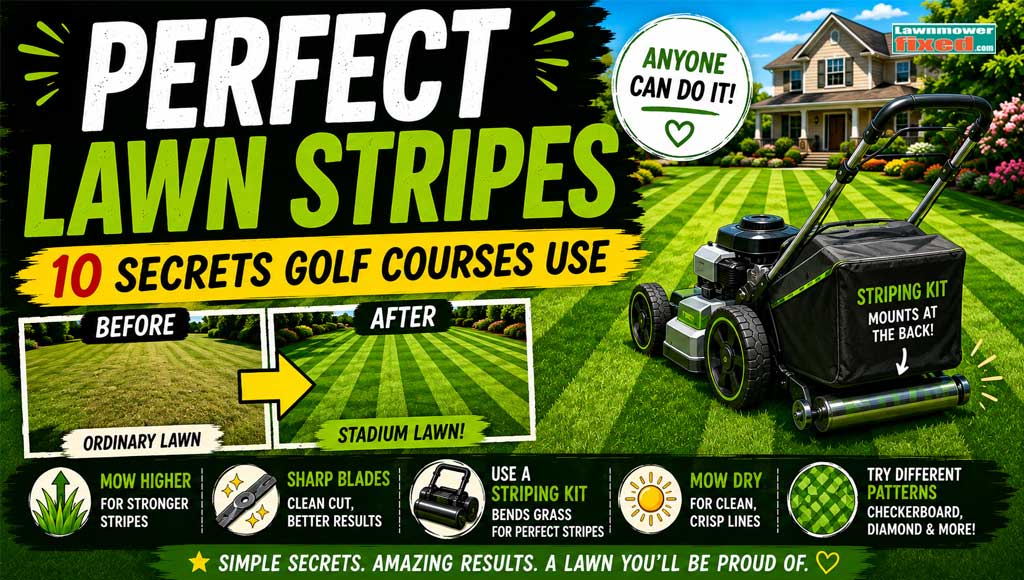
There’s something deeply satisfying about a striped lawn.
Maybe it’s because we’ve all seen those beautiful patterns on golf courses, football pitches, and stately homes. Whatever the reason, a freshly striped lawn somehow makes the whole garden feel more polished.
The good news?
You don’t need a groundskeeper’s budget or professional equipment to create stripes at home.
Most homeowners already have everything they need.
The secret isn’t fancy machinery.
It’s understanding how lawn stripes actually work.
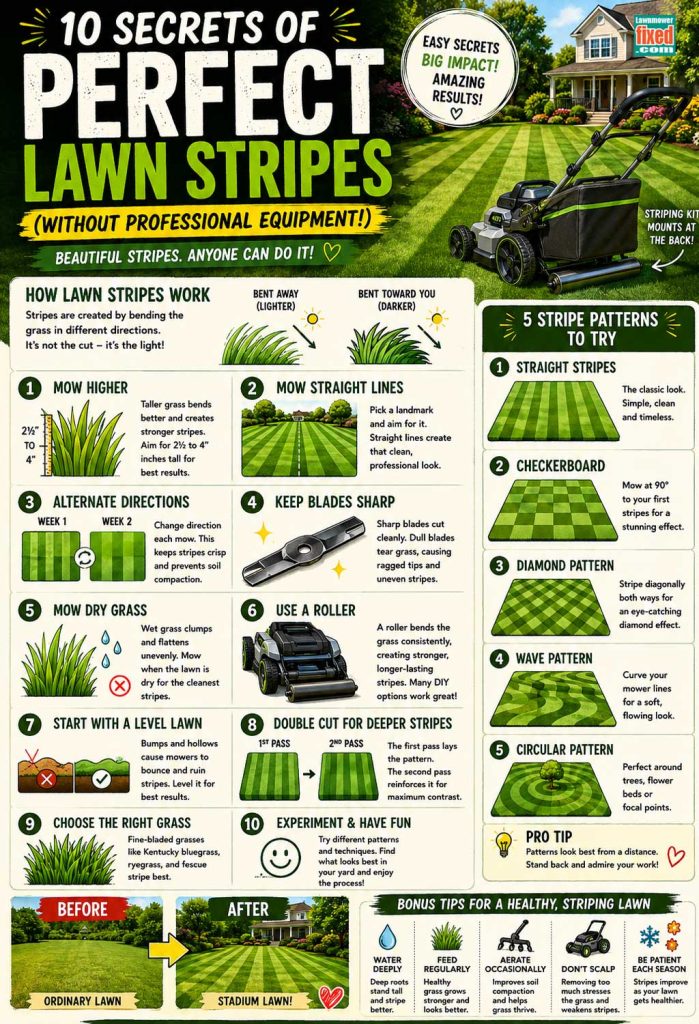
Secret #1: It’s All About Bent Grass
One of the biggest surprises for beginners is that lawn stripes aren’t created by cutting the grass at different heights.
They’re created by bending the grass in different directions.
When grass bends away from you, it appears lighter because more sunlight reflects off the blade.
When it bends toward you, it appears darker.
That’s it.
No paint.
No special grass.
Just light reflecting differently.
Secret #2: Mow Higher for Better Stripes
Longer grass creates stronger stripes.
Short grass struggles to bend and hold its position.
If you’re chasing that golf-course look, raise your cutting height slightly.
Most cool-season lawns look their best when kept around 2½ to 4 inches tall.
The bonus is that taller grass also copes better with drought, foot traffic, and summer stress.
Secret #3: Start With a Level Lawn
Even the best striping setup will struggle on a bumpy lawn.
Every hump and hollow causes the mower to bounce, making the stripe pattern look uneven.
A smooth lawn creates clean, professional-looking lines.
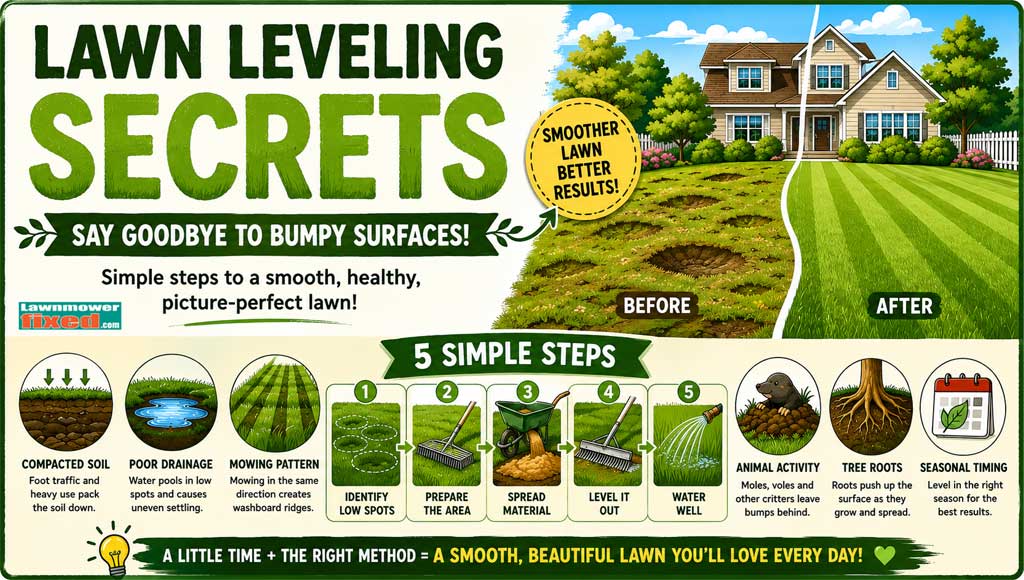
This is one reason lawn levelling has become so popular in recent years.
Secret #4: Sharp Blades Matter
A dull mower blade tears grass.
A sharp blade cuts it cleanly.
Clean cuts help grass stand upright and create a more consistent appearance across the lawn.
If your stripes look fuzzy or uneven, check the blade before doing anything else.
Secret #5: Stripe Dry Grass
Morning dew and wet grass can spoil a good stripe pattern.
Wet grass tends to clump and flatten unpredictably.
For the cleanest results, mow when the lawn is dry.
You’ll get sharper stripes and a cleaner cut.
Secret #6: Use a Roller
This is where the magic happens.
Professional groundskeepers use rollers behind their mowers to bend the grass consistently.
You don’t need anything fancy.
Many homeowners attach:
- A lawn striping kit
- A lightweight roller
- A section of rubber matting
- Even a length of heavy hose
Anything that gently bends the grass can help create stronger stripes.
Secret #7: Keep Your Lines Straight
The eye notices crooked stripes immediately.
Pick a landmark in the distance and aim for it.
A fence post.
A tree.
A corner of the house.
Focus on the target rather than the grass directly ahead.
Your stripes will instantly look more professional.
Secret #8: Alternate Directions
Never mow the same pattern forever.
Changing direction helps prevent soil compaction and encourages upright growth.
Try rotating between:
- Vertical stripes
- Horizontal stripes
- Diagonal stripes
The lawn will stay healthier and the patterns will remain crisp.
Secret #9: Double Cut for Stadium Stripes
Want deeper contrast?
Mow the lawn twice.
The first pass lays down the pattern.
The second pass reinforces it.
Sports fields often use multiple passes to create those dramatic light-and-dark bands you see on television.
Secret #10: Try Different Patterns
Straight stripes are only the beginning.
Once you’ve mastered them, experiment with:
Checkerboard
Stripe one direction.
Then stripe again at 90 degrees.
Diamonds
Create diagonal stripes in one direction.
Repeat diagonally in the opposite direction.
Waves
Use gentle curves instead of straight lines.
Circular Patterns
Perfect around trees, patios, or focal points.
These patterns instantly make a lawn stand out.
My Favourite Pattern
For most gardens, I think the checkerboard pattern gives the biggest visual impact for the least effort.
It’s simple to create but looks far more complicated than it really is.
Visitors always assume it took far longer than it actually did.
The Bottom Line
Perfect lawn stripes aren’t about expensive equipment.
They’re about understanding a few simple principles.
Keep the lawn healthy.
Keep the blade sharp.
Mow a little higher.
Use a roller if possible.
And most importantly, have fun experimenting with different patterns.
A striped lawn won’t make the grass grow any faster, but it will make you smile every time you look out the window.
And that’s reason enough for me.
See you in the garden,
—Tara 🌿
- About the Author
- Latest Posts


John Cunningham is a Red Seal Certified Tech with 25+ years of wrenching.
Bringing hands-on expertise to LawnmowerFixed.com, John writes practical repair and lawn care guides with a passion for keeping outdoor equipment running smoothly.